

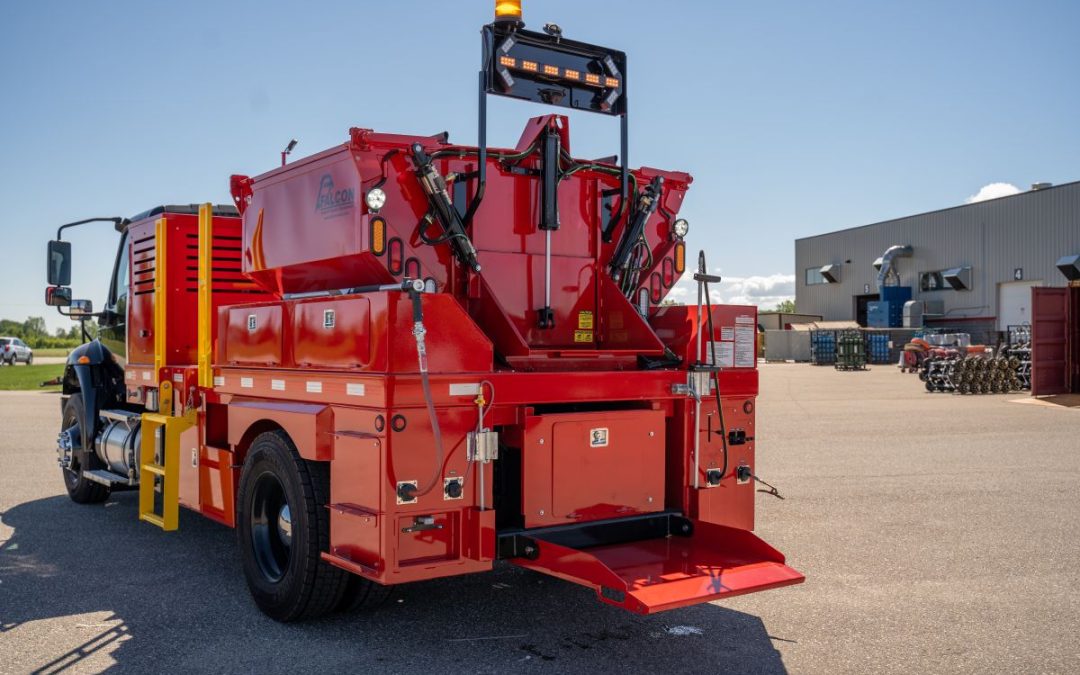
For municipalities and contractors responsible for maintaining large roadway networks, pothole repair is rarely a one-off task. It’s a structured, repetitive operation, often carried out across planned routes where crews may complete dozens or even hundreds of repairs in a single shift.
At that scale, the question is no longer whether a crew can make a quality patch. It’s whether they can make that same quality patch consistently, efficiently, and without constant downtime between stops.
Two of the best and most common options for this scale of pothole repair are fully-integrated patch trucks and truck-mounted hot boxes. Both are used for pothole repair, but they are fundamentally different in how they are built and how they perform in high-volume, repetitive conditions.
The Real Decision: Built-Out System vs. Purpose-Built Machine
Most customers evaluating these systems are already past trailer-based solutions. They’ve typically moved to truck-based equipment for reasons such as:
- Limited space for towing trailers in urban environments
- Existing truck fleets that they want to leverage
- Regulatory requirements that restrict trailer use
So the decision becomes: build a system around a truck-mounted hot box, or invest in a dedicated patch truck designed for the entire workflow from the start. That distinction matters more as workload increases.
The “Fixer-Upper vs. New Home” Comparison
A useful analogy is comparing this purchasing decision to buying a home. In this scenario, buying a truck-mounted hot box is like buying a fixer-upper with “good bones”, and buying a patch truck is like buying a new, fully built home.
With a truck-mounted hot box, you start with a core heating and material unit, then build outward:
- Add a compactor or roller solution (often carried on a second truck)
- Add a tack tank (also carried separately from the hotbox)
- Add storage for tools, washdown systems, and air equipment
- Coordinate how crews move between those components in the field
It’s flexible, but it’s also assembled piece by piece.
A patch truck, on the other hand, is engineered as a complete system from day one. Every component is designed to work together as part of a single workflow, not as add-ons that need to be integrated later.
Why Patch Trucks Exist: Built for Repetitive Route-Based Work
Patch trucks are designed specifically for high-frequency, stop-and-go pothole repair routes where crews are constantly moving from one repair to the next.
The focus isn’t just on transporting hot mix—it’s on completing a full, repeatable repair cycle at every stop with minimal interruption.
That’s why patch trucks integrate the entire repair process into one vehicle, rather than distributing it across multiple systems.
A Complete Onboard Repair System
Unlike a hot box setup that primarily focuses on material delivery, a patch truck is built to execute every step of a permanent pothole repair.
A fully equipped patch truck allows you to have all of the following features on board:
- Tack system – ensures proper adhesion and bonding on every repair
- Compactor – achieves proper density and long-term durability
- Washdown system – cleans tools, shovels, and the machine itself throughout the shift
- Spoils bin – dedicated space for removed asphalt and debris from potholes
- Torch system – supports tack application or material heating when needed
- Air wand/compressor – clears loose debris before repair for a clean base
These systems are not optional add-ons. They are built into the workflow so crews can move from step to step without leaving the truck or coordinating separate equipment.
Where Truck-Mounted Hot Boxes Require More Infrastructure
Truck-mounted hot box systems (such as slip-ins, hook lifts, and chassis mounts) are effective for heating and transporting asphalt, but they are not complete repair systems on their own.
To match the functionality of a patch truck, crews typically need additional assets such as:
- A second truck for a compactor or roller
- A separate vehicle carrying a tack tank
- Independent storage for washdown tools, air tools, and jobsite equipment
This introduces more coordination at every job site:
- More vehicles to stage
- More equipment to manage between stops
- More variability in how each repair is completed
In low-volume or flexible operations, this modularity can be useful. But in high-volume, repetitive route work, it creates friction that compounds throughout the day.
Designed for Dedicated, High-Frequency Crews
Patch trucks are built for crews that are not just patching roads occasionally, but doing it continuously.
For many municipalities and contractors, this means:
- Daily pothole repair routes during peak season
- Winter and freeze-thaw repair cycles
- Large service areas requiring consistent, repeatable workflows
At this level of activity, efficiency isn’t just about speed per repair; it’s about minimizing variation between repairs and keeping crews moving without interruption.
Patch trucks are designed specifically for that environment.
Custom-Built for Real Field Conditions
Patch trucks are also highly configurable, allowing them to be tailored to the specific needs of municipalities and contractors.
For example, we designed a custom patch truck for a customer in Oklahoma City that required a unique compaction solution. The truck was built with a hydraulically lowering platform that carries a roller directly on the vehicle. When needed, the platform lowers to ground level so the crew can use the roller directly for compaction without relying on separate equipment.
This is just one example of how patch trucks can be adapted. Many additional customization options are available. The goal is not a standardized machine; it’s a system built around how crews actually work in the field.
Two Viable Approaches, Two Different Philosophies
When comparing patch trucks to truck-mounted hot box systems, the difference comes down to system design philosophy.
- Truck-mounted hot boxes are modular and flexible, allowing crews to build a solution by combining multiple pieces of equipment
- Patch trucks are fully integrated, purpose-built systems designed to execute every step of pothole repair from a single platform
For high-volume, repetitive pothole repair routes, that distinction becomes critical. Patch trucks eliminate the need to coordinate multiple vehicles and disconnected systems. Instead, they provide a complete, repeatable workflow—tack, cleaning, heating, compaction, and material handling—all built into one machine.
When crews are responsible for completing hundreds of repairs across a single route, that level of integration translates directly into greater consistency, fewer delays, and a more efficient overall operation.

Recent Comments